Contribute
| A Summer Afternoon Of Storytelling – My American Story |
Manorama Choudhury and Rita Pandey
10/01/2026
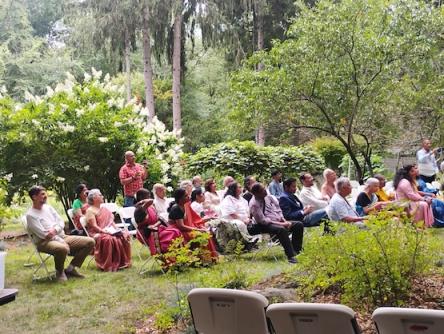
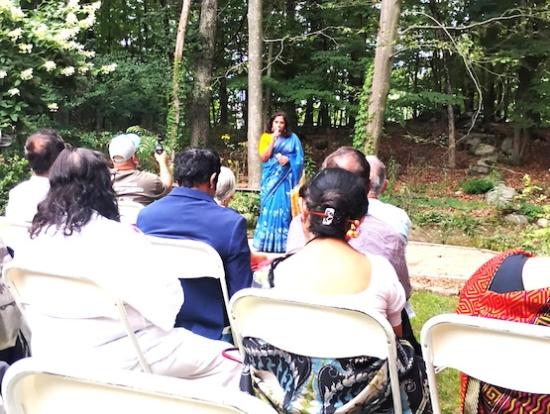
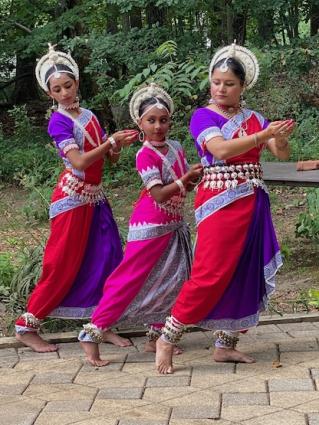
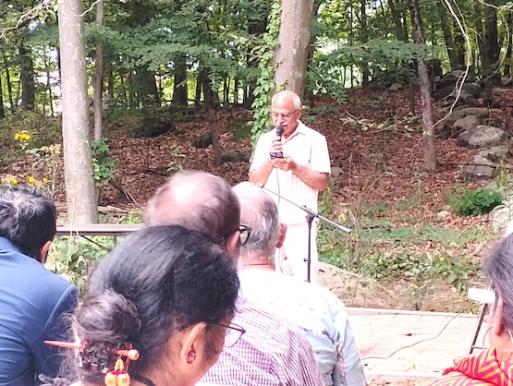
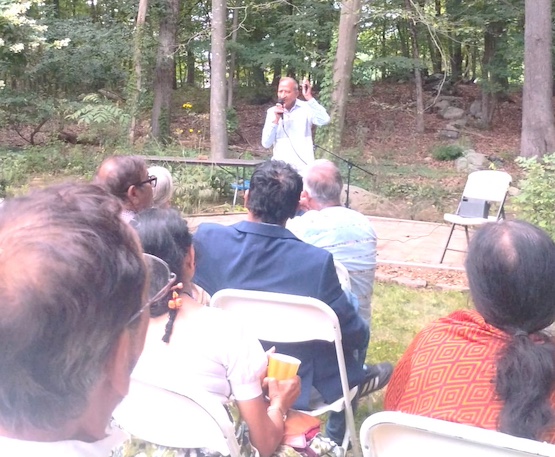
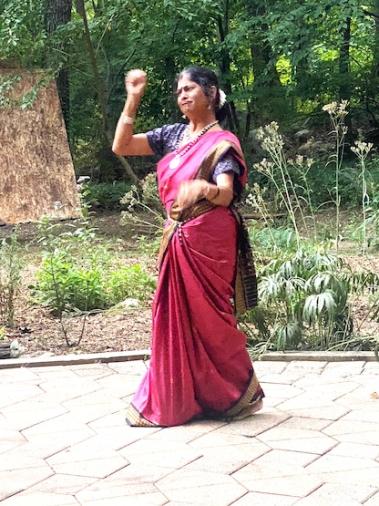
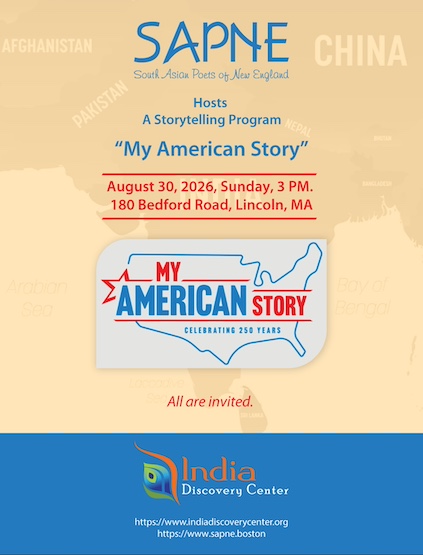
Report by Manorama Choudhury and Rita Pandey India invented storytelling. Shared stories created knowledge. Storytelling created metaphors and imagination. The gestures, the eyes and tone created drama, storytelling became a performance. The communication was polished; books were written; India became the land of drama. Any thought could be mapped to the human body through symbolic limb movement of Indian classical dance. Stories graced temples, stones were carved. Stories created the prolific Indian literature. An India poetry group formed in Boston thirty years ago to help promote Indian languages among the immigrants. The group did quarterly poetry meetings and then planned a meeting of storytelling. The United States was turning 250 years of independence, the immigrants expressed themselves not too far from the freedom trail of 1776. The summer was waning; the air was still. The blossoms were high, the birds lightly chirped, the squirrels paused – the nature prepared herself to hear the immigrant stories. They had the event “My American Story”. The date was August 30, 2026, the venue the backyards gardens at the home of Bijoy and Subarna Misra in the town of Lincoln, MA. The group respected the tradition by a dance performance by the students of Guru Jayashree Mohapatra. It was an invocation to an old deity Jagannatha in Odisha, India, a wooden deity supposedly looking over the universe. The Odias believed all stories merged with the deity. The dancers made a respectful ovation. Bijoy Misra, the Convener of South Asian Poets of New England, followed to outline the afternoon. He tried to simulate an imagined first story. The story is of a person who found a source of water and shared with gestures. He told the story in single syllable expression. We try our best to communicate! Kishan Chakrabarty explored the very idea of what makes a story. He drew upon the mythology of India as inscribed in legends. He recalled the story of Dasyu Ratnakar, whose chanting of “mara, mara” gradually became “Rama, Rama”. Rama is a revered deity. He contrasted it with a story from the Mahabharata illustrating how attachment can lead to sorrow. Stories are indeed our teachers. Manorama Choudhury, through My Engagement, shared a chapter from her own life. She shared the story of meeting and becoming engaged to her future husband before her journey to America. Told with humor and memories of life’s unexpected turns, her story offered a glimpse into how the dream of a distant foreign land begins to take shape in the imagination long before the journey actually begins. Stories let one dream. Rita Pandey, in Journey as a Bride, transported the audience back to her arrival in America as a young bride. She narrated her abrupt dispersal to a new land without training or caution. She recalled how dreams of a fairy-tale beginning were interwoven with anxiety. Hardly anyone welcomed her, hardly anyone spoke. Young maidens carry a romantic view; the world is business and competition. Storytelling then found its voice through music as Maneesh Srivastava sang “Ye Jeevan Hai,” the familiar Hindi song reflecting on the many shades and rhythms of life. “Dear friend, accept life! This is called life!” – Birds from the trees chirped. Maya De, through Journey on Assignment, offered another path to America, one that began with an official assignment. Her story unfolded as she worked to establish herself professionally while searching for an Indian/Bengali connection in the new country. She recalled the joy of meeting a young Bengali couple who had freshly arrived in the US. She and the wife Papiya connected right away. Papiya let Maya meet her future husband Alok! Story is connection. Sajed Kamal looked back at his education at the Loomis School in Connecticut and the experiences and values that shaped the life that followed. Drawing upon American history, he offered a thought that resonated beyond his own story: much of what we enjoy today exists because someone before us paid for it. In turn, we carry a responsibility to contribute toward the world we leave for future generations. Story transmits conduct. Shahab Ahmad expressed his Life in the US through a ghazal of his own composition and humorously recalled watching a hen and the ten chicks cross a highway. His wife compared their crossing to his own crossing over the seas to America, a lighthearted metaphor for the immigrant journey. Story relaxes. Neena Wahi recalled searching for her first job in America and navigating the unfamiliar world of interviews. In the process, she found herself negotiating between the identity she had brought with her, including her love of wearing a sari and bindi—and the new professional identity she felt she needed to create. Her story captured a familiar dilemma of adjustment. Story educates. Rahul Ray offered a sobering historical perspective. While many of us came to America by choice, he told stories of countless Africans who were forcibly brought here as enslaved people. He sang the African American spiritual “Many Thousands Gone,” famously performed by Paul Robeson. The story underscored that as America celebrates 250 years, this part of its story must not be forgotten. Story reminds. Alok De fondly looked back on his 56 years in America; a journey that has taken him across 35 states, into numerous community organizations and history museums, and brought him hundreds of native friends. Metaphorically, he described himself as riding a donkey that keeps moving forward while he continues to look backward; a fitting image for an immigrant life shaped by the present while carrying memories of the past. Story is real! Geeta Patil recalled arriving in America as a student and confronting loneliness: the discomfort of a beginner, and the uncertainty of feeling lost in an unfamiliar place – the emotion of a bird out of the cage. Over time, she came to the realization: feeling lost does not mean failure. Losing a way is the beginning of finding a new way. Let us begin a new story! Parmit Kumar Singh reached into Indian mythology through the legend of Vishwamitra, whose long journey toward becoming a Brahmarshi was marked by trials and temptation. His retelling reminded how stories of human aspiration, struggle and transformation continue to travel across centuries. Obstacles are education, remain positive! Samrat Chakravarty, the son of Dr. Kishan Chakrabarty, reflected on finding his place as a brown-skinned actor in a predominantly white industry and his determination to retain his original name. Drawing strength from his family’s immigrant journey, he observed that the names inherited from our forefathers have become threads in the fabric of this 250-year-old nation. Invoking Tagore’s prem, puja and prakriti, he spoke of loving one’s community, believing in something greater than oneself, and remaining connected to nature. Story is truth, hail to the youth! Vasant Machwe, a retired professor of physics, spoke movingly of the loss of his wife and the loneliness that followed. He reflected with gratitude on how life in America opened new avenues for learning and self-expression, including finding his voice through SAPNE. His story was a gentle reminder that even through loss, new connections, learning and purpose can help us continue the journey. Story is an education! Koaley Das shared her experience of moving from London to America several decades ago. Though the early years brought loneliness, she spoke with gratitude for the opportunities she found in America, where she raised her family and gradually found a community that gave her a sense of belonging. Story is grateful thanks! The afternoon came to a musical close with Odissi Guru Jayashree Mahapatra presenting “Kahin Gale Murali Phunka,” a much-loved Odia song, leaving the gathering on a warm and nostalgic note. The maiden Radha searches for her beloved to hear his flute! Trees and plants showered flowers. Birds listened. Satyendra Sharma, the Executive Director of India Discovery Center proposed a vote of thanks. A light supper was served. All appreciated the efforts of Subarna Misra in letting all meet in her well-cared garden. Anjana Bose took care of the setup and food. Early immigrant Sunil Das and the Lokvani journalists Anil and Ranjani Saigal were among the attendees. Chow-Chin Chuang took the pictures and Maneesh Srivastava captured the video. The pictures are archived in https://sapne.indiadiscoverycenter.org/ and the video is published at https://youtu.be/gVSVcQsknSQ India Discovery Center is an educational initiative operating from Lincoln, MA. https://www.indiadiscoverycenter.org A Summer Afternoon of Storytelling – “My American Story”
You may also access this article through our web-site http://www.lokvani.com/