
Contribute
| Vision-Aid Launches Ability Bazaar –Talent With Disabilities. Apps Without Barriers. |
Press Release
08/06/2026
Vision-Aid opens Ability Bazaar — a marketplace where people with disabilities build your websites, apps and accessibility audits, to earn livelihoods. Vision-Aid asked the question: how do we help people with vision loss live with independence and dignity by getting the world to hire them for their talent?” Ability Bazaar (www.abilitybazaar.com) is the answer. Inside the Ability Bazaar training centre: learners with disabilities at work with screen readers, headphones and 200% zoom — learning to build the web, and to audit it. (Photo: Vision-Aid) The simple version We took a group of people with disabilities — blind, low vision and others - and trained them in AI tools, web development and digital accessibility. They now do real commercial work. They build websites and applications of any size or complexity. And they run accessibility audits that tell an organisation whether its site actually works for someone using a screen reader, a magnifier, voice control or other assistive aids and technology AI does the heavy lifting. A team of agents built on Google’s Gemini models runs the back office end to end: structuring each incoming request, scoping and pricing the work, crawling the site with our own scanning engine — ABLE, the Accessibility Barrier Locator Engine — and drafting the report. What AI does not do is have the last word. Fndings are verified by a human expert with a disability, on real assistive technology, before it reaches a customer. That verification step is not a courtesy. It is the product. An automated checker will tell you a button has no label. It will not tell you that your donation form is technically compliant and still impossible to complete with a screen reader, because the error message appears somewhere the screen reader never announces. Only someone who lives inside that experience can tell you that. At Ability Bazaar, lived experience stops being a line in the brochure and becomes the methodology. And it is not charity work. It is paid work, at market rates, invoiced like any other vendor. Every delivered order pays wages to an expert with a disability. Two engines, one storefront Ability Bazaar brings together two things Vision-Aid had already built. The services engine is our Digital Accessibility Testing and Training Center, which has sold accessibility testing since 2019 to universities and enterprises in the United States and India — WCAG 2.2 audits, VPAT and ACR conformance reports for procurement, and assistive-technology usability testing that no automated tool can imitate. Its testers are professionals who are blind, have low vision or other disabilities, trained on an internationally recognised curriculum with Deque University certification, across twelve training batches and counting. The products engine is our AI Development Center, which has already shipped SEP AI Tutor — a voice-first spoken-English coach built for and with visually impaired learners, supporting more than twelve Indian languages — with further apps, Arohi and Nidra, in the pipeline. Ability Bazaar is the front door that distributes them, and the platform on which disability-led teams can build the next ones. See it for yourself There is a short tour of the marketplace on the homepage — how the agents run it, and who does the work: youtu.be/u_31A5QMfoA. Watch it before you read any further, if you have a minute. It explains the model better than we can in print. What Vision-Aid’s Ability Bazaar sells, and what it costs • Free — an instant ABLE screening of any single page, right on the site. Most people are surprised by what it turns up on their own homepage. • $199 — a full accessibility scan of an entire website, with WCAG 2.2 findings grouped by severity and the page and element for each. Report in your inbox in one day. • $500 — a simple static website, up to ten pages, accessible by design and certified to WCAG 2.2 AA before handover. Prototype in five days; you get the source code. • $1,000 — a dynamic website — accessible forms and logins, and content you can edit yourself. Working prototype in ten days. • Custom — human audits, VPAT and ACR documentation, assistive-technology testing and full app development, scoped with you. Custom estimates provided within two business days. Five ways you can help, most of them in five minutes 1. Run the free scan. Put your own organisation’s homepage through the instant screening at abilitybazaar.com. It costs nothing and takes a minute. If it comes back clean, wonderful. It usually does not. 2. Order the $199 scan. For your employer, your temple or gurdwara, your child’s school, your clinic, the nonprofit whose board you sit on. One day, one report, one honest answer. 3. Commission a website. If anyone you know needs one built or rebuilt — a small business, a startup, a shop, a community organisation — $500 for a static site and $1,000 for a dynamic one is well below market, and accessible from the first line of code. 4. Forward this to one person. Truly, one. A single introduction to someone who is shopping for a website or worrying about a compliance review is worth more to us than a dozen general good wishes. 5. Sponsor a trainee. $300 puts one student with a disability through three to six months of one-to-one AI and accessibility training, from beginner to platform-ready professional; $5,000 sponsors a full eighteen-student cohort. It is invoiced as a workforce-development engagement, not a donation — and today’s sponsored student is next quarter’s paid expert. Why you should There is a business case, and Vision-Aid makes it briefly. Accessibility is moving from good practice to requirement. Under the U.S. Justice Department’s Title II rule, state and local government entities serving populations of 50,000 or more must bring their web content to WCAG 2.1 Level AA by April 26, 2027, with smaller entities and special districts following on April 26, 2028 — and that obligation flows down to the vendors who build and host for them. In Europe, the European Accessibility Act has applied to a wide range of consumer-facing digital services since June 2025. If your organisation sells to a university, a public agency or a European customer, someone will ask you for a conformance report sooner than you think. It is considerably cheaper to find out now, for $199, than in the middle of a procurement review. “But that is not the real reason, and we would rather be straight with you about it” – said Vision-Aid in a statement. “The real reason is that a $500 website order is not really a $500 website order. It is several days of skilled, dignified, paid work for someone who has had to fight for every inch of the professional life most of us were simply handed. We have sat with people at our training centre who had been told, gently and repeatedly and by people who meant well, that they should lower their expectations. They are now shipping production code and writing audit reports that universities and enterprises pay for. That’s what we want to see more of. We are not asking you for a donation. We are asking you to buy something you probably need anyway, from people who are unusually good at making it.” How to reach Ability Bazaar Browse and order at www.abilitybazaar.com. Try the free screening while you are there. Or write to info@visionaid.org, About Vision-Aid Founded in 2004 and headquartered in Lexington, Massachusetts, Vision-Aid is a volunteer-driven 501(c)(3) nonprofit whose mission is enabling, educating and empowering the visually impaired to live with independence and dignity. Working with leading eye hospitals and blind schools across India, Vision-Aid reaches more than 100,000 beneficiaries a year at 75-plus locations, and holds a four-star rating from Charity Navigator. More than 500 people with disabilities have been trained through its programmes. Ability Bazaar is a Vision-Aid initiative. www.visionaid.org · www.abilitybazaar.com · info@visionaid.org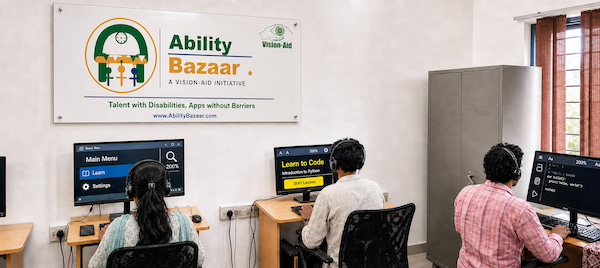
You may also access this article through our web-site http://www.lokvani.com/
