Contribute
| In Conversation With Captain N Ravikanth, INS Sudarshini At Boston Harbor |
Nirmala Garimella
07/15/2026
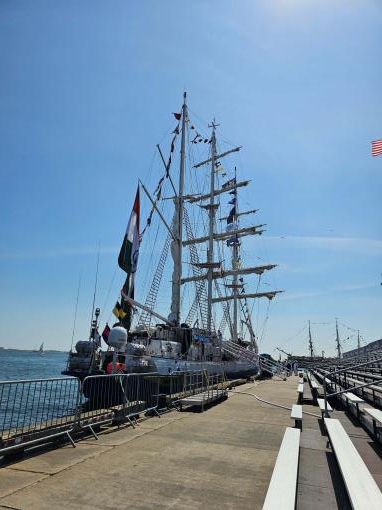
The pride and passion of Commanding Officer N. Ravikanth and his crew shone through at Boston Seaport on a warm summer day last week when I had the privilege of meeting them aboard the INS Sudarshini. As the Indian Navy's tall ship eased into port on the evening of July 11th, the crowd — overwhelmingly Indian Diaspora families who'd been waiting for days — broke into chants of "Bharat Mata ki Jai," the kind of welcome, the ship's captain says, he'd only ever heard at a cricket match back home. Sudarshini is six months into "Lokayan," the longest voyage an Indian Navy training vessel has ever undertaken: ten months, 22,000 nautical miles, thirteen countries. I sat down with her Commanding Officer, N Ravikanth, on board, mid-mission, to talk about the journey so far — the records, the near-disaster off Egypt, and what it's meant to be welcomed, port after port, by strangers who cook you dinner. How did this mission come together in the first place? It goes back four years. The first planning meetings happened in 2020, and the Indian Navy formally approved the mission in 2022. The timing wasn't a coincidence — 2026 is America's Sail 250 commemoration and also the International Naval Review, and France is marking 400 years of its own sailing heritage this year too. When you've got that many major maritime anniversaries lining up in one year, a tall ship is the ideal way to be part of all of it. We're technically both a tall ship and a warship — if we were ever called to war, we could be retrofitted with weapons and sensors — so we were well suited to take part in both the sail celebration and the naval review. We have two ships built for this kind of voyage, Sudarshini and her sister ship Tarangini. Tarangini has done the last five editions of Lokayan. This time, it was decided that Sudarshini would go. I took command in May of last year, so I've been aboard for about fourteen months now, with six more to go. Give us the scale of it. Where has this voyage taken you? Ten months, January to November, 22,000 nautical miles across thirteen countries and eighteen ports — twenty-one port calls in total since we repeat a few stops on the way out and back. It's already the longest Lokayan mission in the Navy's history; the previous record was eight months. The route took us from Cochin to Salalah in Oman, then we'd originally planned for Jeddah, Saudi Arabia, but they were tied up with their own fleet review and the regional airspace situation wasn't favorable, so we rerouted through the Red Sea to Safaga, Egypt — a first port call for either of our ships. From there, Alexandria, then Malta, then across the Atlantic to Cabo Verde, Antigua and Barbuda, Norfolk, Baltimore, New York, and now Boston. This is the first time either of our sail ships has ever operated outside the Indian Ocean. I understand you set a record crossing the Atlantic under sail alone. "The Atlantic is a completely unforgiving ocean," with sudden shifts from sunny skies to torrential rains and 50 mph winds that once pushed us back eight miles in a single hour. "But keeping the Indian flag flying high across the Atlantic under sail alone... that was the highlight of our journey." We did — nineteen continuous days from Cabo Verde to Antigua and Barbuda, entirely under sail. Not a single minute of engine use. That broke our own previous best of thirteen days. I'll admit that record only really holds within the context of Indian Navy sail training vessels — sailing ships have crossed oceans under canvas alone since the 1700s — but for us, using only sail for that long, in that kind of open Atlantic weather, was genuinely something. You mentioned a serious incident near Alexandria. What happened? Just a day out of Alexandria, on our way to Malta, our propeller got fouled in fishing nets and rope. It locked up completely and severely damaged the gearbox on one engine. That left us running on a single engine, capable of no more than four or five miles an hour, and we were still several days from Malta. The safer option would have been to turn back — Alexandria was only about a day and a half away. But that would have meant missing the events in France and not making it to the United States at all. So, the real question was not operational; it was moral: do I risk the safety of more than eighty people on board to keep the mission on schedule, or do I turn back and let the mission fail? Headquarters in Delhi gave me a call to make myself — they said, you are the captain; decide what is best, and we will support it. I chose to continue. The winds were against us at first. But about halfway through, they shifted in our favor, and we ended up covering the distance under sail alone and reaching Malta a day ahead of schedule. Fortune favors the brave, as they say. What's Boston's welcome been like compared to the other U.S. ports? Boston has been the most overwhelming reception of the whole trip — more than other cities where we had our highest single-stop turnout at around 12,500 people over four days. Here, in just the first couple of days, we already had more than 2,500 visitors, and that is with the gangway only open four or five hours a day. What is struck all of us is that people didn't just come to look at the ship — they wanted to take care of us. Families showed up with home-cooked meals so the crew wouldn't have to cook. That kind of welcome, halfway around the world in a country none of us had been to before, means something. It's happened at other ports too, but Boston has been something else entirely. What does an ordinary day look like for the crew, ten months into a voyage like this? It starts around six or six-thirty with tea — no engine starts without caffeine, as I tell the crew. Then a bit of yoga or quiet time on deck to watch the sunrise, which is a luxury most warship crews don't get, since they're usually enclosed. From there it's departmental work — engineering, navigation, communications — interspersed with maintenance on the sails and rigging, cadet training, and duty watches in rotating shifts. Evenings are free time: chess, arm-wrestling, dancing on the upper deck. Once a week, we set up a proper spread on deck under the stars. Officers, sailors, and cadets all eat the same meals and wear the same unranked sailing gear at sea — there's no galley for officers and a separate one for everyone else. When you're climbing the same rigging together, rank doesn't really hold up. Any moment from this journey to Boston that's stayed with you personally? The whale sighting, for sure. Just off Cape Cod, on the tenth of July, we spotted a majestic blue whale mother and calf on the starboard side — something the whole crew had been hoping to see the entire trip, especially after Baltimore and New York. "People pay fortunes to go out and see that. “We had the luxury of having them guide us right into Boston. “People pay a lot of money to go whale watching, and we got it for free, mid-voyage. After fourteen months in command, what have you taken from it about leadership? Four things, really. Preparation — I've come to believe in something like ninety percent preparation, ten percent effort, rather than the other way around. Courage, which isn't only physical — deciding whether to press on to Malta on one engine was a moral decision more than anything else. Teamwork, which only means something if the person leading is also willing to pull the same rope. And integrity — understanding that everyone on this ship has different strengths, and that a crew only works if you build around that instead of around hierarchy. Any final thought you'd want people back home — or here in Boston — to take away from this voyage? There's an adage in the seafaring world: borders divide people on land, but the sea has none. When ships cross each other out on open water, we salute — not just as formality, but as a kind of mutual respect. If one ship is in trouble, others help, regardless of flag. More than seventy percent of this earth is water, and I think that's the best argument there is for the idea that we're all one family, as they say, ‘Vasudeva Kutumbam.’ This mission, in its own small way, is just trying to put that into practice, one port at a time. The Journey Home The Sudarshini will remain in Boston until July 25th to undergo mandatory maintenance before embarking on the second half of its massive journey. From here, they will head to the Azores, Lisbon, Barcelona, Italy, and transit back through the Suez Canal to Egypt and Saudi Arabia. If all goes according to plan, the crew will drop anchor back in Cochin, India, on November 5th—just in time to celebrate Diwali with their families.
You may also access this article through our web-site http://www.lokvani.com/