Contribute
| Surpanaka Reimagined: A Study In Desire, Defiance, And Devastation |
Meena Subramanyam
06/24/2026
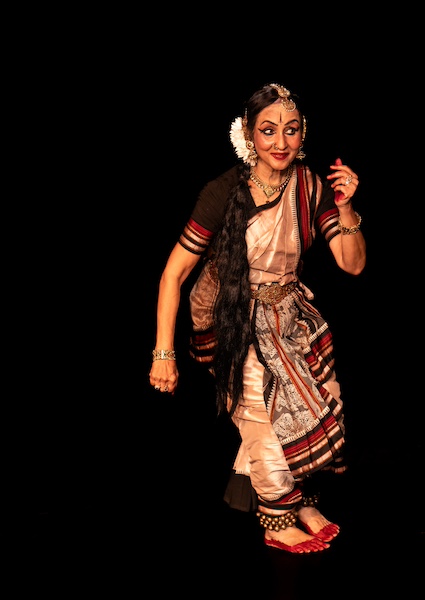
Surpanaka Reimagined: A Study in Desire, Defiance, and Devastation Production staged by Jothi Raghavan as part of the Boston NatyaSamaagam Dance Festival Reflection by Meena Subramanyam, Bharatanatyam Artist, Connoisseur of Performing Arts This reflection is offered from the perspective of a Bharatanatyam artist and guru—one who is deeply invested in the creative journeys of dancers and choreographers that seek to probe beneath the familiar, to uncover new emotional and creative possibilities within well-known narratives. This reflection emerges from that space—one of engagement with the artistic journey—rather than from the lens of a dance critic. Jothi Raghavan, a senior Bharatanatyam artiste, choreographer, and guru, is widely regarded as a torchbearer of classical tradition in the diaspora—her work marked by a rare balance of technical precision, expressive depth, and a sustained commitment to nurturing the next generation of dancers In her compelling solo dance-theatre production Surpanaka, Jothi Raghavan draws from Kamban’s Ramavataram to re-center a marginal yet catalytic figure of the Ramayana. Rather than treating Surpanaka as a mere narrative device, the production interrogates her emotional landscape—her longing, humiliation, fury, and relentless agency—transforming her into a deeply human, if troubling, protagonist. Structured across five vividly delineated scenes, the work unfolds with dramaturgical clarity. From Surpanaka’s entrance into Panchavati to her final incitement of Ravana, Jothi’s narrative arc was both faithful to the textual source and imaginatively reinterpreted through Bharatanatyam’s expressive idiom. The choreography allowed her to traverse striking emotional contrasts, embodying Surpanaka as both grotesque Rakshasi and alluring maiden—a “chameleon” figure whose shifting identities mirror the complexities of desire and power. The opening scene established a volatile presence: the untamed energy of Surpanaka is palpable as she disrupts the forest landscape, her gaze arresting upon Rama. The transformation sequence—from monstrous to seductive—was particularly effective, offering scope for nuanced abhinaya. Here, Jothi negotiated not only external form but also internal fragmentation, and the choreography evocatively supported this transition. The second and third scenes intensified the emotional stakes. Surpanaka’s overt declarations of desire, tinged with arrogance and self-mythologizing, are met with Rama’s ironic detachment. This interplay provided fertile ground for interpretive subtlety. Jothi’s interpretation stood out in its evocation of Surpanaka’s interiority—her oscillation between passion, delusion, and despair. Her hallucinations—portrayed elegantly by Jothi as embracing clouds imagining it be Rama—suggested a psyche unraveling under the weight of unfulfilled longing. Jothi presented the mutilation episode not as a moment of shock, but as an embodiment of Surpanaka’s psychological trajectory. It emerged less as a punitive act and more as a violent rupture that exposes the fragility of her constructed identity. The aftermath that was depicted vividly by Jothi was particularly striking: stripped of beauty, Jothi emoted Surpanaka’s voice in defiant clarity asserting that a woman cannot bear to see her beloved’s affection directed elsewhere. This resonated with the rasikas with unsettling universality, inviting empathy even as her actions were repelling. In the final scenes, Surpanaka’s turn to vengeance layered with irony was depicted in a sophisticated manner by Jothi. Her description of Sita to Ravana was at once admiring and manipulative, setting in motion the epic’s central conflict. Jothi’s portrayal through vachika (suggested through music) and angika converged to depict a mind both wounded and calculating. This finale underscored Surpanaks’s role not just as instigator, but as a figure shaped by denied desire and bruised dignity. The production effectively underscored her role as the inadvertent architect of the epic’s central conflict. Musically, Sudha Raghuraman’s composition provided a textured soundscape that supported the complex emotional gradations of the narrative. The score balanced lyricism with dramatic tension, enabling the dancer to inhabit states of longing, rage, and despair without overt sentimentality. What distinguished this production was its refusal to simplify Surpanaka as a villain or victim; rather, Jothi’s portrayal gave life to a figure shaped by desire and denied dignity, whose choices—however destructive—stem from an insistence on agency. Jothi Raghavan’s conceptualization invited the audience to confront discomfort: to witness not just the consequences of Surpanaka’s actions, but the emotional truths that drive them. In reimagining Surpanaka through a Bharatanatyam lens, this production expanded the interpretive possibilities of classical repertoire. It challenged performers and rasikas alike to engage with complexity, reminding us that even within well-trodden epics, there remain untold stories waiting to be embodied.
You may also access this article through our web-site http://www.lokvani.com/