Contribute
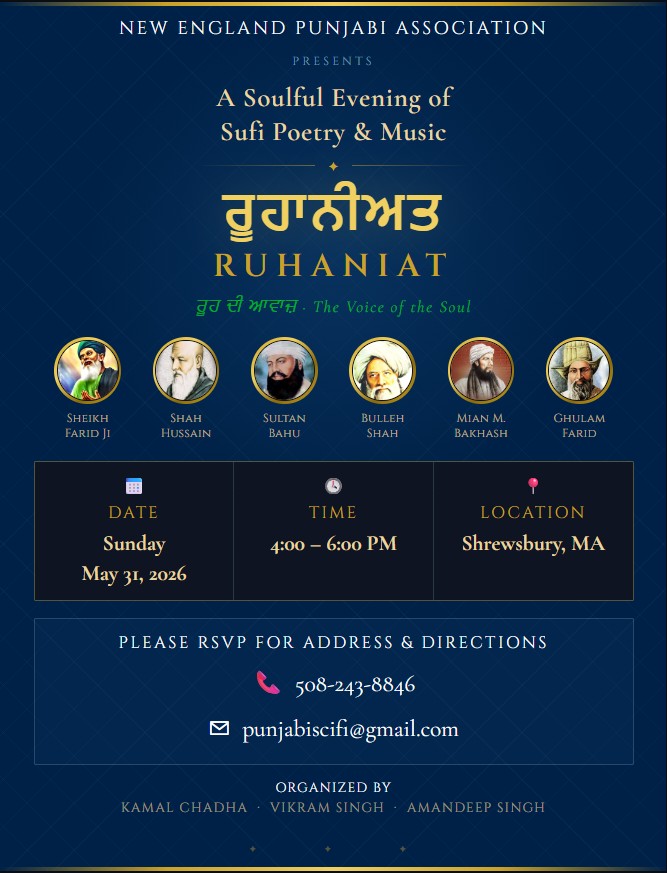
| An Evening Of Soulful Sufi Poetry And Music |
Amandeep Singh
06/13/2026
Sunday, May 31, 2026. Shrewsbury, MA. It was a pleasant spring afternoon turning into the tranquil hues of dusk. The New England Punjabi Association hosted a Kavi Darbar and musical program dedicated to Sufi poetry, filling the air with a sense of spirituality (or ruhaniat).
The term "Sufi" is derived from Arabic, meaning "wool." In ancient times, Islamic ascetics (fakirs) wore woolen garments, thus earning the name "Sufi." However, Sufism is more than a style of dress; it is a philosophy of spirituality, deeply linked to mysticism. It posits that union with God, along with a form of knowledge and spiritual awareness beyond human intellect, can be attained through contemplation and self-surrender.
The event began with Roop Jyot Kaur presenting a paper on Punjabi Sufi poetry, explaining its duality of being both serious and simple at the same time. Rejecting religious fanaticism, Sufi fakirs expressed their thoughts using the local vernacular—employing familiar imagery, symbols, and poetic forms like slokas and kafis—which resonate deeply with the human heart. This is why these songs remain popular centuries later. Sufi poetry represents a total immersion in the love of God, elevating human love to a spiritual status, often termed "ishq-e-haqiqi" (true divine love), which deeply touched the hearts of the masses.
Sufi poetry stands as a glorious pillar of medieval Punjabi literature. It is inherently rebellious and revolutionary; to be a Sufi is to be a warrior of the spirit. By challenging religious dogma and risking their lives, the Sufis championed universal unity—a message that remains vital today.
Bulleh Shah wrote: "Bansi Waliya Kahna Ranjha, tera sur hai sab da sanjha" (O Flute Player Kahna Ranjha, your sweet voice belongs to all).
"Hindu na nahi Musalman. Bahiye trinjan taj abhiman." (Neither Hindu nor Muslim. To enjoy the company of friends, one needs to shed ego.)
Martyrdom is highly revered in Sufi poetry. Waris Shah wrote, "Sir dittiyan bajh na ishq pakke, eh nahi sukahlian yaarian" (Without sacrificing one's head, love does not mature; these friendships are not easily won).
Sultan Bahu echoed the same sentiment:
"Ashiq hove ta ishq kamawe, rah ishq da sui da nakka, dhaga ho ta jave" (A true lover earns love; the path of love is as narrow as the eye of a needle—you must become as fine as a thread to pass through).
The greatness of the Punjabi language is evident in how poets like Baba Sheikh Farid and others composed verses expressing human love, sorrow, and longing. Dr. Harpreet Singh, a Harvard scholar of South Asian traditions and languages, highlighted the vernacularization of languages in South Asia, noting that while the state was the instrument of vernacularization elsewhere in the subcontinent, religion served this role in the Punjab. Vaishnavas, Jogis, Sufis, and Sikh Gurus all expressed their thoughts in Punjabi, the common language of the people.
Local Boston poets Roop Jyot Kaur, Dr. Harpreet Singh, Prof. Subhash Chandra, and Pritpal Singh Mirzapuri captivated the audience by reciting works by Sheikh Farid, Shah Hussain, Sultan Bahu, Bulleh Shah, Mian Muhammad Bakhsh, and their own compositions. Following the poetry session, renowned music teacher and All India Radio artist, Prof. M. Rama Rao, who has dedicated his life to music education, performed alongside his students—Amandeep Singh, Harman Deep Singh, Naresh Agarwal, Kamal Chadha, Krishna Bhaskaran, Girish Satpute, and Ammara Nawaz Khan. They enthralled the audience with Sufi songs, kafis, qawwalis, and ghazals. Shri Rajesh Pai accompanied them on the tabla. Hosts Roop Jyot Kaur and Vikram Singh were instrumental in organizing the program. Participants hailed from India and Pakistan, a testament to the universal appeal of Punjabi Sufi poetry. This unique evening left an indelible mark on all who attended.
You may also access this article through our web-site http://www.lokvani.com/