Contribute
| Cambodian Juggad - Chickens And Bamboo Train |
Uday Virkud
03/05/2026
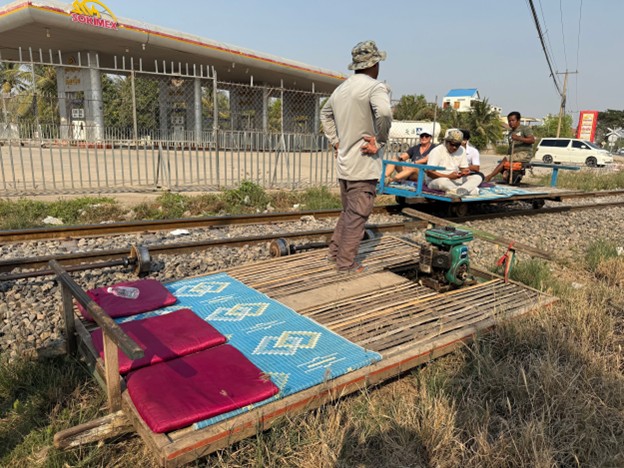
Cambodian Juggad Chickens and Bamboo Train by Uday Virkud My recent Siem Reap, Cambodia visit had many fun aspects that I enjoyed thoroughly. Of course the main attraction is the world heritage Angkor Wat temple and many other thousand year old ancient temples and sites that tell a story of a prosperous and powerful empire that dominated this region of Asia a long time ago. While the majestic monuments represent the riches and prosperity of the region at that time, they also clearly show the scars of continuous war and destruction that this region has experienced for a millennia. You see many sculptures and monuments defaced, which likely happened many centuries back during the period of religious transition between Hinduism and Buddhism. And the destruction continued centuries later with the conflicts among the regional warring factions. You also notice in dismay bullet holes in several places, from more recent conflicts between the greater global powers, fighting their ideological battles, and sadly Cambodia was caught in between. Despite a thousand years of natural decay, in addition to the human destruction, these monuments still stand tall, to provide you with a glimpse into their grandeur from the bygone era. Even with the continuous trauma experienced by the people in this country, I found them quite resilient and optimistic. Cambodia is a relatively underdeveloped country, with GDP per capita around $2,600 and steadily rising. I found the people in Siem Reap very welcoming and the infrastructure quite clean and developed for tourism. The entire tourist economy transacts in dollars for ease, and the place is very affordable. Abundant tropical fruits to enjoy. Fruit juices, shakes, and coconut water for just a dollar at every corner. And for the brave, plenty of exotic food to try, from bugs, frogs, and even snakes. But their staple is rice and curries similar to Thailand, but a lot less spicy. In addition to the temples, I had read about the bamboo train in a town called Battambang, about 150 km from Siem Reap. I wanted to experience that ride. So I booked a car for the day. A nice SUV with a driver to take me there and bring me back for about a hundred dollars, not bad. A nice Toyota SUV was waiting to pick me up at noon from the hotel, when I had planned to leave. A journey around 3 hours one way, so I should be able to take the train ride and return back by dinner time. The vehicle looked nice and clean but the driver didn't speak a word of English. No problem, Google Translate comes to the rescue. We start the journey in my comfortable air-conditioned ride. As we left the town and hit the highway, I heard some noises coming from the back. First, I thought it may be from outside. But then it came again and again. It was more like a soft flutter. I tried asking the driver, but it was difficult to communicate with him while he was driving. In about an hour, we stopped to get some water. I got out of the car and asked him what’s in the back of the car? We opened the car trunk, and there it was, a box with live chickens that he was transporting along with me. It was the chickens that were clucking, flapping, and making noises. In addition, there were few sacks full of produce. I suppose he was taking these goods in the car with me to deliver to someone in another town along the way. I wasn’t very happy, but I suppose he was trying to maximize the transport efficiency. I was told later that this is quite common in Cambodia, but it is not something they do with tourists. Along the way then he stopped at couple places to deliver his cargo of chicken and produce. A couple of hours later around 3:00 PM, we reach this place from where you can take the Bamboo Train rides. There were no tourists in sight. Just a few locals lounging and smoking in a yard. I was worried and wondered if I was at the right place. With difficulty and with help from Google, I asked one of them, and he said, I have to wait for half an hour and it will cost me ten dollars. I tried to argue that the media says the ride is only five dollars. Later I figured that because I was by myself and if I wanted to ride alone, it would be ten dollars minimum. If I would join one or two others, it would be five dollars. While I waited, another car arrived with a couple of Japanese tourists and their guide who could speak English. I was relieved. I learnt from him that the bamboo train rides will start around 3:45 PM after the intercity train passes through. In a few minutes, a regular big train rumbles through on the tracks by the yard. And then, the people lounging around get in action. By then a few other tourist cars arrived and the place now looked more like a tourist destination. I guess, they all knew better when to arrive for the rides. So what are these bamboo trains? It is Cambodian ingenuity, to maximize use of existing infrastructure for efficient and cheap transport of people and goods. A lightweight bamboo platform is laid on two sets of small wheels. It is powered by a small motor laid on the platform to run this low-cost makeshift assembly on the regular tracks. Since the intercity train frequency is very low, the locals know exactly when to run these makeshift bamboo trains to transport people and goods between villages along the tracks. Very quickly, one of the locals who was our train driver placed two pairs of wheels on the tracks. Then moved the bamboo platform with the small motor that was lying by the side on top of these wheels. He placed three cushions on the platform for tourist seating comfort. Me and the two Japanese tourists were on this ride. And we were ready to go for a 45 minute ride on this bamboo train. The bamboo train can go at top speed of 30-40 km per hour. As it approaches local road crossings, the driver slows down and carefully crosses. The local traffic allows them to pass as I suppose, this tourist attraction is helping the local economy. We rode across a few fields, passing by small villages, and also over a few bridges crossing small rivers. We were riding on this platform under the open sky with the sun blazing on top of us. It was great! Then we turned around on the same track by reversing the engine. On the way back, we saw other bamboo trains approaching us with a few more tourists. It’s a single-track corridor. Now what? The two opposing bamboo trains slowed down as they approached and stopped. Our driver asked us to get down, and with the help from the other train driver, calmly lifted the platform and the two sets of wheels from the tracks and placed it down beside the tracks. The other train moves forward and passes. Then they quickly place back our train wheels and platform on top. And again “all aboard” and off we go. We had to do this a couple of times. There was a clear understanding of which train had the right of way, but both drivers helped each other in disassembly and assembly, quickly and efficiently. At one end of the journey, there was a makeshift shack by the tracks where a lady was selling water, beer, and coconut water. A five-minute break, and we head back to our station. An exhilarating 45-minute ride. Now the bamboo trains are mainly a tourist attraction, as the Cambodian road infrastructure has developed. Still, you see some use of these bamboo trains for local transport along the way. They were the main mode of transport in this region a few decades ago. A true Cambodian ingenuity to maximize use of limited infrastructure. First, transporting chicken with me in the tourist car, and then the bamboo train. That day, as I traveled, I experienced firsthand “Cambodian Juggad”! *Jugaad is a Hindi/Punjabi term for a flexible, frugal, and innovative approach to problem-solving that uses limited resources to create a quick, often unconventional, fix. It refers to "hacking" or "working around" constraints, such as using discarded parts to build machines or finding creative solutions in daily life. The Author, Uday Virkud, is a resident of Wayland, MA
You may also access this article through our web-site http://www.lokvani.com/