
Contribute
| Listening Across Lineages: Four Hindustani Classical Voices At LQ Music Festival 2026 |
Akash Deep
02/12/2026
For newcomers to Indian classical music, the word gharana can sound forbidding. At its simplest, a gharana is a way of thinking about music. It is a tradition shaped by generations of teachers, students, and shared musical values. The 2026 LearnQuest Music Festival offers a rare chance to hear how different gharanas approach the same core idea: a raga, unfolding in time. This year’s four Hindustani vocalists—Gautam Kale, Piu Mukherjee, Dhananjay Hegde, and Bhuvanesh Mukul Komkali—represent four distinct musical lineages, each with its own personality. Gautam Kale sings from the Mewati tradition, a gharana closely associated with clarity, devotion, and emotional directness. Popularized by Pandit Jasraj, the Mewati style places strong emphasis on bhava—the feeling and intent behind the notes. Listeners often notice the meditative quality of the music, where the raga unfolds patiently, and words carry spiritual weight. Pandit Jasraj famously described music as a form of upasana, or spiritual practice. That idea runs deeply through the Mewati gharana: singing is not just performance but an offering. Kale’s training under multiple gurus, including Pandit Jasraj, gives his singing a grounded, reflective quality that even first-time listeners often find accessible. The Banaras tradition, represented by Piu Mukherjee, offers a contrasting experience. Rooted in a city where classical and semi-classical music coexist naturally, the Banaras style is known for its lyrical grace and expressive storytelling. The tradition has been shaped by a remarkable line of vocalists who became cultural icons, including Begum Akhtar, often called the Mallika-e-Ghazal, and Girija Devi, frequently described as the Queen of Thumri. Contemporary artists shaped by this lineage continue to move fluidly between genres, preserving the Banaras emphasis on feeling, language, and communication. Singers like Piu Mukherjee, who performs khayal, thumri, dadra, and tappa, exemplify this continuity—bringing classical discipline together with narrative expressiveness. Listeners unfamiliar with classical music often find the Banaras aesthetic immediately inviting because of its melodic warmth and close connection to poetry and mood. Dhananjay Hegde brings yet another perspective through his grounding in not one but two gharanas--Kirana and Gwalior. At first glance, these traditions seem to represent opposite ends of Hindustani classical music: Kirana is inward-looking and meditative, while Gwalior emphasizes structure and clarity. Yet many musicians, including Hegde, draw from both, revealing how gharanas function in practice—not as rigid categories, but as complementary ways of thinking. The Kirana gharana is best known for its slow, detailed exploration of individual notes. Rather than rushing through melodic patterns, Kirana exponents—such as Ustad Abdul Karim Khan and Pandit Bhimsen Joshi—linger on each swara, allowing listeners to hear its emotional color and relationship to the raga. The Gwalior gharana, considered one of the oldest khayal traditions, takes a different approach. Here, structure matters deeply. The raga is presented through well-defined bandishes, with clear rhythmic articulation and logical development. Leading figures of this tradition include Pandit D. V. Paluskar and Pandit Omkarnath Thakur. Hearing a Kirana–Gwalior blend reminds listeners that gharanas are not walls, but lenses—each sharpening a different aspect of the same musical truth. Hegde’s training under the vocal Maestro Pandit Vinayak Torvi of Bengaluru, allows him to balance introspection with clarity, combining emotional depth with formal precision. Bhuvanesh Mukul Komkali comes from a lineage that famously resists easy categorization. His grandfather, Pandit Kumar Gandharva, challenged the very idea of rigid gharanas, arguing that music must evolve through listening and lived experience. As a result, Bhuvanesh’s music emphasizes originality and intellectual engagement with the raga rather than adherence to a fixed stylistic formula. For audiences, this often translates into unexpected phrasing, rare compositions, and a sense that the raga is being discovered in real time rather than presented as a finished object. Heard together, these four artists reveal why gharanas still matter—not as rigid labels, but as different answers to the same musical question. At LearnQuest 2026, audiences will be able to experience these answers side by side, discovering how tradition shapes sound, and how individual voices keep it alive. LearnQuest Music Festival 2026 April 3 – at Tull Hall, MIT, Cambridge, MA April 4 and 5 – Casey Theater, Regis College, Weston, MA
You may also access this article through our web-site http://www.lokvani.com/

Gautam Kale

Piu Mukherjee
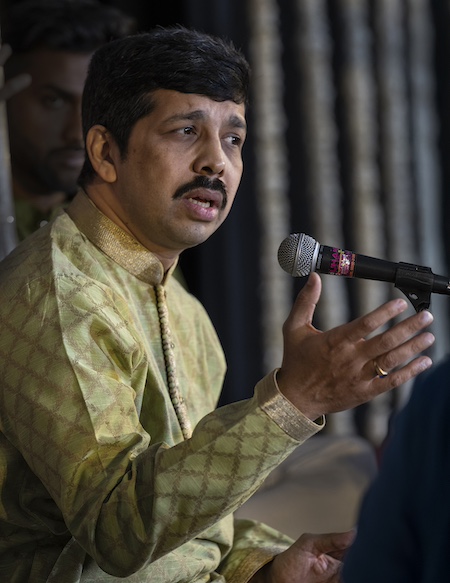
Dhananjay Hegde
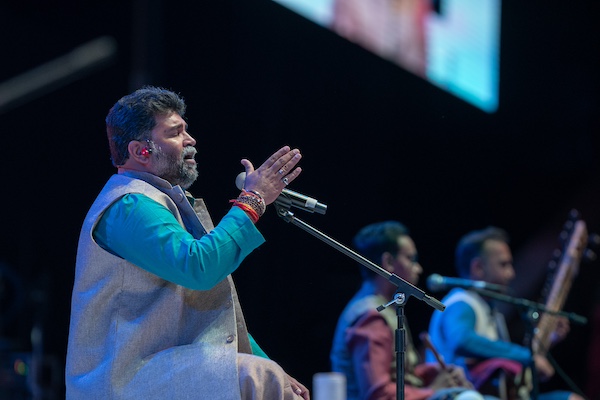
Bhuvanesh Mukul Komkali