Geeta Jayanti
"We find in our shaastra (spiritual texts) an exhaustive SCIENCE OF LIVING by which we can redeem even the worst within us." - Swami Chinmayananda
Geeta Jayanti is celebrated around the world on Shukla Paksha
Ekadashi in the Hindu month of Margashirsh. It is also known as Moksha Ekadashi. It usually falls in the month of December according to the Gregorian calendar. This day commemorates the day when Sri Krishna gave Arjun the knowledge of Brahma Vidya and Yoga Shastra. It is the 'birthday' of the Bhagwad Geeta.
Bhagwad Geeta literally means "The Song of the Lord." It is a part of the Mahabharat. It is sometimes referred to as the Fifth Veda. Through 18 chapters and 700 shlokas, Bhagwan Krishna teaches us about Action (karma), Knowledge (jnana), and Bhakti (supreme devotion.)
The Bhagwad Geeta is considered by eastern and western scholars alike to be among the greatest spiritual books the world has ever known. In a very clear and wonderful way Sri Krishna describes the science of self-realization and the exact process by which a human being can establish their eternal relationship with Ishwar. Its intrinsic beauty is that its knowledge applies to all human beings in all ages and does not postulate any sectarian ideology or secular view.
The Geeta is the epitome of all the holy Granths (texts). It is said to contain the essence of all the Vedas. Its style is elegant, after a little bit of study one can follow the words. It is said that Sri Krishna recited the Geeta to Arjun in a single day, though this has not been corroborated. But the knowledge contained in it is so deep that it takes a whole lifetime to understand it. Every time one reads it, a new facet is presented. Hence the Geeta remains eternally new.
The Geeta is narrated by Sanjay, who has been granted the gift of Divine Vision, being able to see events happening at a distance. He narrates to the blind king Dhritarashtra the events unfolding on the battlefield of Kurukshetra.
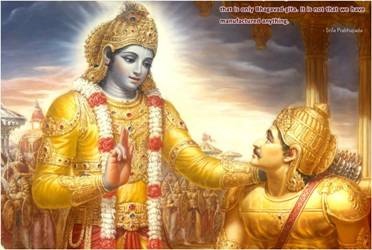
The first chapter lays the ground for unfolding of the consequent chapters. The two armies of the Pandavas and Kauravas face off against each other. Arjun looks at his opponents and sees his family members and elders; his Gurus, his revered grandfather, his cousins and friends, and is dejected. He feels weak, his body trembles, and his bow slips from his hand. He asks his charioteer who is none other than Bhagwan Krishna, to take him to the middle of the battlefield so that he can see his opponents closer. There, in the midst of the battle lines, Sri Krishna teaches him what his duty as a Prince is and gives us all the knowledge of the Geeta.
The Bhagwad Gita covers two important aspects of Hindu Thought: Brahma Vidya and Yoga Shastra. Together they form the complete teaching of the Gita. In fact, it is the totality of the Hindu way of life.
The Geeta uses the battlefield, Kurukshetra, as a metaphor for the human mind to address the problem of conflict and grief. All problems arise from the fundamental human problem of the inadequate self. The sense of inadequacy arises from the ignorance of the real nature of self. The teaching of the Geeta opens with the assurance that there is no cause for grief. Sri Krishna teaches that every being is a complete, adequate self. That knowledge alone eliminates the sense of inadequacy. Conflicts and grief vanish, and happiness becomes natural, effortless.
The Bhagwad Geeta is a book for life, a treasure chest full of jewels. A tool to develop a mind that is tranquil and open – a learning mind. For each one of us, it is necessary to possess a contemplative mind, free from likes and dislikes which are an obstacle to the knowledge of the self.
The hope is that as one grows, the wisdom in the Geeta grows with them. Each one of us is Arjun. May we always carry Sri Krishna in our hearts, that he becomes our true friend for life, so we will never be alone.